


Discover the protective pattern that may be keeping you stuck.
Take the free 2-minute quiz and get personalized insights delivered to your inbox.
What's Keeping You Stuck?


When Life Gets Better but You Don’t Feel Better Yet
Why safety, stability, and even happiness can feel strange after you’ve spent a long time surviving
You made it through the thing.
Maybe you left the relationship. The crisis ended. The baby finally sleeps for more than forty-five minutes at a time. The medical appointments slowed down. You got the job, moved into the house, finished treatment, set the boundary, or reached whatever version of after you spent months—or years—trying to get to.
Things are objectively better.
So… why don’t you feel better?
Instead, maybe you’re still anxious. Still exhausted. Still waiting for something to go wrong.
You finally have an evening with nothing you have to do, and instead of relaxing, you feel restless.
Someone you love is quiet and your brain immediately starts investigating.
Things are going well at work, so naturally you begin wondering what you’ve forgotten.
Your relationship is stable, but some part of you keeps looking for evidence that it isn’t.
And sometimes the good moments themselves feel strangely uncomfortable—like enjoying them too much might somehow tempt fate.
If you’ve spent a long time surviving, getting to safety and actually feeling safe are not necessarily the same thing.
Your nervous system didn’t get the memo
When life has required you to stay alert for a long time, your brain and body get really good at it.
That’s not dysfunction. That’s adaptation.
You learn to anticipate what might happen next. You notice subtle changes in someone’s tone. You plan three steps ahead. You keep moving because slowing down means things might fall apart.
Maybe those skills genuinely helped you survive something difficult.
The problem is that your nervous system doesn’t necessarily throw them away the moment your circumstances change.
There isn’t a little switch that flips from:
WE HAVE A PROBLEM.
to:
Never mind, everybody. We’re good now. Take the afternoon off.
Your circumstances may have changed much faster than your internal alarm system has.
So even when nothing is actively wrong, your body may still be operating according to an old rule:
Stay ready.
Calm can feel suspicious when chaos was familiar
People sometimes assume that if you’ve experienced enough chaos, peace should feel amazing.
And eventually, it might.
But at first?
Peace can feel fucking weird.
Predictability can feel boring.
Rest can make you anxious.
A healthy relationship can feel almost too quiet.
Having nothing urgent to fix can leave you wandering around mentally looking for something you forgot.
When your system is accustomed to intensity, the absence of intensity doesn’t always register immediately as safety.
Sometimes it registers as:
Something is about to happen.
So you wait.
You scan.
You overthink.
You create contingency plans for problems that haven’t happened.
You might even find yourself getting irritated, picking at something that’s going well, filling every free minute, or returning to familiar patterns you genuinely thought you’d outgrown.
That doesn’t necessarily mean you want chaos.
It may mean calm is still unfamiliar.
And unfamiliar doesn’t automatically feel safe.
Sometimes you feel worse after the crisis
This one can really mess with people.
You held it together while everything was falling apart.
And then things finally settled down…
…and that’s when you fell apart.
What the hell?
During periods of acute stress, there often isn’t much room to process what’s happening.
You’re dealing with what is directly in front of you.
Make the appointment.
Feed the kids.
Answer the email.
Pay the bill.
Get through today.
Repeat.
Then the immediate threat, demand, or crisis decreases.
Suddenly there is space.
And sometimes all the shit your brain politely put in the “we absolutely do not have time for this right now” folder starts showing up.
The exhaustion.
The anger.
The grief.
The memories.
The realization of just how hard the last year actually was.
You may look around at a life that is finally becoming manageable and wonder why now you’re struggling.
But struggling after survival doesn’t mean you’re going backward.
Sometimes it means your system finally has enough breathing room to acknowledge what survival cost you.
You might not know who you are when you’re not managing a crisis
Survival mode can become an identity without you realizing it.
You’re the capable one.
The fixer.
The person who figures shit out.
The one everyone calls.
You anticipate problems before they happen. You keep the plates spinning. You make sure everyone else is okay.
And then life gets quieter.
Now what?
When so much of your time, attention, and identity has been organized around managing problems, peace can leave an uncomfortable amount of empty space.
You may realize you don’t actually know what you enjoy anymore.
You might struggle to answer seemingly simple questions:
What do I want?
What sounds fun?
What would I do if nobody needed anything from me?
Sometimes healing isn’t immediately discovering the answers.
Sometimes it’s tolerating the weirdness of not knowing yet.
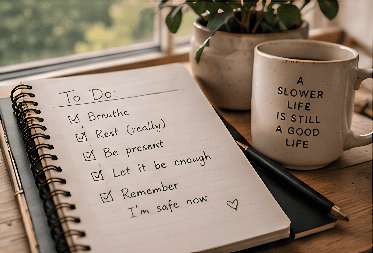
Healing can include learning that calm isn’t a trap
We tend to picture healing as getting rid of symptoms.
Less anxiety.
Fewer triggers.
Better sleep.
Less overthinking.
And yes, those things can absolutely be part of it.
But healing can also involve increasing your capacity for things that once felt unfamiliar or unsafe.
Rest.
Joy.
Connection.
Being cared for.
Letting somebody else handle it.
Not knowing exactly what happens next.
Leaving something unfinished until tomorrow.
Having a good day without preparing yourself for the punishment you assume must follow it.
You may have to experience safety repeatedly before your nervous system starts believing it.
That can look surprisingly ordinary.
Nothing terrible happened when you rested.
The relationship survived the disagreement.
You said no and the world kept spinning.
Someone was disappointed and you survived their disappointment.
You asked for help and weren’t abandoned.
You had a good day—and it was simply a good day.
Those experiences matter.
They give your brain new information.
Maybe I don’t have to stay ready all the time.
You don’t have to force yourself to “enjoy it”
There can be another layer of pressure when life improves:
I should be happy.
I should be grateful.
Other people have it worse.
This is what I wanted. Why can’t I just enjoy it?
Unfortunately, criticizing yourself for not feeling safe faster doesn’t usually make your nervous system feel particularly safe.
You don’t need to perform gratitude for your healing to count.
You can appreciate what you have and still be adjusting to it.
You can love the life you’re building and grieve what happened before you got here.
You can know intellectually that you’re okay while your body is still learning what okay feels like.
Those aren’t contradictions.
They’re part of being human.
Therapy can help with the part that happens after
Therapy isn’t only for surviving the crisis.
Sometimes some of the most meaningful work happens when the immediate crisis is over.
That’s when there may finally be room to understand the patterns that developed around it.
Why does rest make me anxious?
Why do I assume someone’s angry with me?
Why do I feel responsible for everybody?
Why am I always waiting for the other shoe to drop?
Why does my body react so strongly when I know I’m safe?
Approaches like trauma-focused therapy and EMDR can help people work with experiences that continue to feel emotionally or physically present even when they logically know they’re over.
And sometimes therapy is also about something much less dramatic:
learning how to have a life that isn’t organized around survival anymore.
Figuring out what you like.
What you want.
What matters to you.
What relationships feel reciprocal.
What rest actually looks like.
What you want to build now that you’re not spending every ounce of energy just getting through.
Maybe nothing is about to go wrong
If you’ve spent years waiting for the next crisis, that sentence might feel almost laughable.
But try it on anyway.
Maybe this quiet moment isn’t the calm before the storm.
Maybe nobody is secretly angry.
Maybe you haven’t forgotten something.
Maybe you don’t need to solve anything tonight.
Maybe the good thing doesn’t have an expiration date you need to predict.
Maybe you’re allowed to be here.
Not because you’ve finally become healed enough, productive enough, grateful enough, or good enough to deserve it.
But because this is your life, too.
The part after survival.
The quiet part.
The ordinary part.
The part where, little by little, your nervous system gets to learn:
Calm isn’t always a warning.
Sometimes calm is just calm.


